
- CustomSearch for Safari 2.0 is a major rewrite of the older CustomSearch Safari Extension 1.4. Future releases will strive to implement more of the legacy feature set. Future releases will strive to implement more of the legacy feature set.
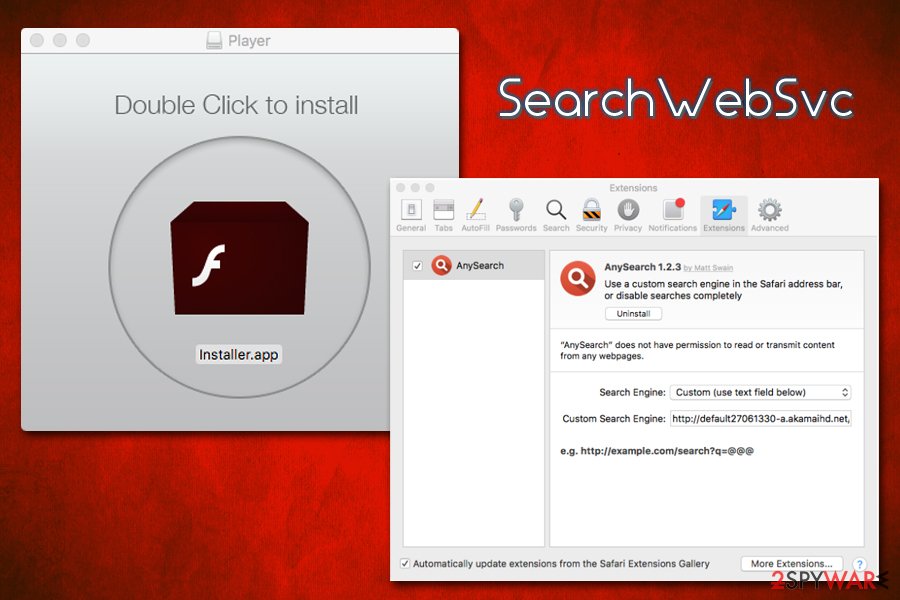
- Mar 08, 2017 The link to install this extension only works in Safari on macOS. After installing the extension, head to Safari Preferences Extensions AnySearch. Choose your preferred search engine from the list or provide the address to a custom search engine. The search engine you choose here will be used whenever you search from Safari’s address bar.
What is Customsearch.info
Customsearch.info is an address that users might see on their Google Chrome, Mozilla Firefox, Safari, or another web browser unexpectedly. Donate Suggested: $10. CustomSearch Safari Extension. Allows you to quickly access search engines and sharing services of your choice via Search Bar, Right-Click, or toolbar button. Ships with entries for searching Wikipedia, Amazon.com, iTunes, TinEye, Google, and Bing, as well as entries for sharing on Facebook, MySpace, and Tumblr. Uninstall Customsearch.info Extension from Firefox. Launch Mozilla Firefox. In the address bar, type: about:addons and press Enter. From the menu on the left, choose Extensions. Look for Customsearch.info or anything related to it, and once you find it, press ‘Remove’. Delete Customsearch.info Extension from Safari.
Customsearch.info is an address that users may see on their Google Chrome, Mozilla Firefox, Safari, or another web browser all of a sudden. This is due to a customized search plugin was set up on the browser without requesting for authorization – potentially undesirable programs are frequently circulated in bogus scheme, which include package of software packets or cheating advertisements/fake updates.
The moment set up, the app will adjust the modes of the web browser by setting hxxps://customsearch.info as a home page and new tab address, and apply a custom search engine. Thus, people who have their web browsers taken over are forced to surf the web via an choice search provider – Customsearch.info routing all analyzes to Yahoo. However, unlike real Yahoo consequences, the browser hijacker shall inject different promotional web links (branded as “Adsâ€) at the top for users to tap and make income for the creators.
Download Removal Toolto remove Customsearch.infoEven if browser attackers such as Customsearch.info are not regarded as a primary safety malware, it is notable that they have a lot to disguise. Custom Search toolbar is just another app that was duplicated from Nebula Search, Blast Search, Storm Search, Mazy Search, and quite a great deal of others. In other words, the publisher keeps circulating the same app under various tittles – one of tons of dubious (but regular) behaviors.
Altering users’ Search provider and home website without any authorization; Stopping people from searching the net via the preferable engine; Injecting sponsored hyperlinks and advertisements into the top of the search outcomes; Overseeing and anonymous, as well as confidential, data; Being hard to uninstall because of different persistence methods.
Details collecting practices are not unlikely, even though entirely superfluous in regards to browser attackers or other potentially unwanted apps. Take note that your information is useful, and it may be sold for profit. In the meantime, you may be oriented by multiple ad campaigns, and they may be highly diligent and bothersome.
Some users can even turn to the hijacker because the Customsearch.info malware, because it may materialize all of a sudden. Despite the fact that not technically precise, this term might be comprehensible, taking into consideration that people spot their web browser mode entirely modified: a new search engine applied, and scours being led to Yahoo.
Application packaging or bogus vouchers are one of those the biggest part of frequent approaches that browser hijackers are spread – those ways generally lead to unintended setup. Without a uncertainty, you need to not stand for such bogus behavior and terminate Customsearch.info from your browser.
Customsearch.info is a browser-seizing program that might not be simple to rule out because of the “owned by your establishment” characteristic it fixes
Download Removal Toolto remove Customsearch.infoHowever, Customsearch.info elimination can in some instances be much harder than you would hope from a standard browser plugin. At the beginning of all, the home page, new tab, and search engine alters may not be directly related to the Custom Search plugin but somewhat a application set up on the machine.
In such a situation, instead of completing regular Customsearch.info delete by right-tapping the plug-in, you shall ought to look for controversial applications installed on your operating system – we say how underneath.
Additionally, the PUP can set the “Managed by your organization†operate on your browser – it is a new ploy employed by hijacker publishers so to stop people from getting rid of not wanted plug-ins. If that transpires, researchers highly recommend you scan the machine in packages with anti-malware, reboot internet browsers, and use computer restore applications like Cleaner Intego for greatest consequences.
How does Customsearch.info functions
Even if possibly undesirable programs might be set up knowingly without comprehending related to their elements, the biggest number of installations transpire behind users’ Backs. Any of the prime offenders for such happening is an application packing – a scheme i.e. employed by the biggest part of free applications distributors and makers. It authorizes the pay-per-install monetization principle (which isn’t always employed for questionable aims, by the way) to be practiced, so third-parties are highly concerned with people set uping added applications. Unfortunately, they are generally going out of their methods so as to carry out the wanted impact and don’t sufficiently display the nonobligatory bits in the installer.
If feasible, stop third-party pages and download applications from the official sources merely; Do not be tricked by deceitful “Download†buttons (this is specially regular on peer-to-peer and other susceptible web pages); As soon as the installation wizard means up, don’t press “Next†until you are performed along with the procedure; If prompted, always choose Advanced/Custom instead of Recommended/Quick mode to remain in regulate of the setup; Study the guide sensibly and get rid of ticks from checkboxes, uncheck all the choices and read the penalty print text; Set up decent anti-a malware program able to pinpoint potentially unwanted apps.

How to erase Customsearch.info
As noted earlier, Customsearch.info deletion ought to not cause prime trouble to the biggest part of. However, in case the app was set up via an open to attack source (for example programs gap), it might have set the “Managed by your organization†condition, which would stop people from switching their browser mode. In such a situation, you should better remove Customsearch.info by rebooting your web browser – analyze the guidelines beneath.
Download Removal Toolto remove Customsearch.infoProvided that the take control of was induced by an set up tool, you need to follow the guidelines below to terminate it by hand. Alternatively, you might simply scan your device together with good anti-a malware application – it will locate all the undesired entries in certain folders of your computer and uninstall the Customsearch.info malware in an automatic way.
Stage 1: Delete Browser Extension
First of all, we would recommend that you check your browser extensions and remove any that are linked to Customsearch.info. A lot of adware and other unwanted programs use browser extensions in order to hijacker internet applications.
Remove Customsearch.info Extension from Google Chrome
- Launch Google Chrome.
- In the address bar, type: chrome://extensions/ and press Enter.
- Look for Customsearch.info or anything related to it, and once you find it, press ‘Remove’.
Uninstall Customsearch.info Extension from Firefox
- Launch Mozilla Firefox.
- In the address bar, type: about:addons and press Enter.
- From the menu on the left, choose Extensions.
- Look for Customsearch.info or anything related to it, and once you find it, press ‘Remove’.
Delete Customsearch.info Extension from Safari
- Launch Safari.
- Press on the Safari Settings icon, which you can find in the upper-right corner.
- Select Preferences from the list.
- Choose the Extensions tab.
- Look for Customsearch.info or anything related to it, and once you find it, press ‘Uninstall’.
- Additionally, open Safari Settings again and choose Downloads.
- If Customsearch.info.safariextz appears on the list, select it and press ‘Clear’.
Remove Customsearch.info Add-ons from Internet Explorer
- Launch Internet Explorer.
- From the menu at the top, select Tools and then press Manage add-ons.
- Look for Customsearch.info or anything related to it, and once you find it, press ‘Remove’.
- Reopen Internet Explorer.In the unlikely scenario that Customsearch.info is still on your browser, follow the additional instructions below.
- Press Windows Key + R, type appwiz.cpl and press Enter
- The Program and Features window will open where you should be able to find the Customsearch.info program.
- Select Customsearch.info or any other recently installed unwanted entry and press ‘Uninstall/Change’.
Alternative method to clear the browser from Customsearch.info
There may be cases when adware or PUPs cannot be removed by simply deleting extensions or codes. In those situations, it is necessary to reset the browser to default configuration. In you notice that even after getting rid of weird extensions the infection is still present, follow the below instructions.
Use Chrome Clean Up Tool to Delete Customsearch.info
- Launch Google Chrome.
- In the address box, type: chrome://settings/ and press Enter.
- Expand Advanced settings, which you can find by scrolling down.
- Scroll down until you see Reset and Cleanup.
- Press on Clean up computer. Then press Find.
This Google Chrome feature is supposed to clear the computer of any harmful software. If it does not detect Customsearch.info, go back to the Clean up computer and reset settings.
Reset Mozilla Firefox to Default
If you still find Customsearch.info in your Mozilla Firefox browser, you should be able to get rid of it by restoring your Firefox settings to default. While extensions and plug-ins will be deleted, this will not touch your browser history, bookmarks, saved passwords or Internet cookies.
- Launch Mozilla Firefox
- Into the address box, type: about:support and press Enter.
- You will be redirected to a Troubleshooting Information page.
- From the menu on the right side, select Refresh Firefox.
- Confirm your choice by clicking Refresh Firefox in the new window.
- Your browser will close automatically in order to successfully restore the settings.
- Press Finish.
Reset Safari Browser to Normal Settings
- Launch Safari.
- Press on the Safari Settings icon, which you can find in the upper-right corner.
- Press Reset Safari.
- A new window will appear. Select the boxes of what you want to reset or use the screenshot below to guide you. Once you have selected everything, press ‘Reset’.
- Restart Safari.
Restore Internet Explorer to Default Settings
- Launch Internet Explorer.
- From the top menu, press on Tools and then Internet Options.
- In the new window that opens, choose the Advanced tab.
- At the bottom of the window, below Reset Internet settings, there will be a ‘Reset’ button. Press that.
While extensions and plug-ins will be deleted, this will not touch your browser history, bookmarks, saved passwords or Internet cookies.
customsearch.info redirect removal instructions
What is the customsearch.info website?
customsearch.info (and find.customsearch.info) is the address of a fake search engine. Rogue web searching tools are usually promoted by software categorized as browser hijackers. One browser hijacker observed promoting customsearch.info is simply named Custom Search. Software within this category promotes fake search engines by making certain modifications to browser settings and restricting/denying access to them. Additionally, Custom Search adds the 'Managed by your organization' feature to Google Chrome browsers. Both browser hijackers and bogus search engines are notorious for their data tracking capabilities. Due to the dubious methods used to proliferate browser hijackers, they are also classified as Potentially Unwanted Applications (PUAs). Custom Search has been observed being proliferated via licensed software 'cracking' tools. As well as being illegal, these activation tools can distribute not just PUAs but also Trojans, ransomware and other malware.
Google Chrome, Internet Explorer, Mozilla Firefox and other popular browsers are typical targets of browser hijackers. They assign the addresses of bogus search tools as the homepage, default search engine and new tab/window URLs. These seemingly minor alterations significantly affect the browsing experience. To elaborate, with a browser hijacker promoting customsearch.info installed (e.g. Custom Search), each search made via the URL bar and new browser tab/window opened redirects to customsearch.info. Fake search engines are usually unable to provide unique results, and so they tend to redirect to (or cause redirection chains ending with) legitimate sites. This is the case with customsearch.info, which redirects to the Google search engine (google.com). Furthermore, recovering a hijacked browser is impossible without removing the software affecting it, since browser hijackers can undo any changes users try to make to their browsers and/or limit/deny access to the settings. Most browser hijackers can track data. They can record browsing activity (URLs visited, pages viewed, search queries typed, etc.) and gather personal information derived from it (IP addresses, geolocations and other details). The collected data is then shared with and/or sold to third parties (potentially, cyber criminals), intent on likewise misusing it for financial gain. Therefore, the presence of features, however, the promised functionality is seldom operational, and this is common to most PUAs. The only purpose of these unwanted apps is to generate revenue at users' expense. Rather than delivering any real value, PUAs can hijack browsers, run intrusive advertisement campaigns, force-open untrusted/malicious sites, and track private information.
How did Custom Search install on my computer?
PUAs are distributed via the download/installation set-ups of other products. This deceptive marketing technique of packing regular software with unwanted or malicious additions is called 'bundling'. By rushing through download/installation processes (e.g. ignoring terms, skipping steps and sections, using 'Quick/Express' options, etc.), many users risk unintentionally allowing harmful and bundled content into their devices. Some PUAs have 'official' promotional web pages, from which they can be downloaded. Intrusive ads can infiltrate these applications into systems as well. When clicked, they can execute scrips, designed to download/install PUAs without users' permission.
How to avoid installation of potentially unwanted applications
You are advised to research all products to verify their legitimacy, prior to download/installation and/or purchase. All downloads must be done from official and trustworthy sources, since dubious download channels such as unofficial and free file-hosting websites, Peer-to-Peer sharing networks (BitTorrent, eMule, Gnutella, etc.) and other third party downloaders commonly offer deceptive and bundled content. Download and installation processes must be treated with caution. Read the terms, study all possible options, use the 'Custom/Advanced' settings and opt-out of supplementary apps, tools, features and other additions. Intrusive ads may seem legitimate, however, they can redirect to highly dubious sites (e.g. gambling, adult-dating, pornography, and so on). If you encounter advertisements or redirects of this kind, check all devices and immediately remove all suspect applications and browser extensions/plug-ins. If your computer is already infected with Custom Search, we recommend running a scan with Malwarebytes for Windows to automatically eliminate this browser hijacker.
Custom Search browser hijacker installation setup (illegal activation 'cracking' tool):
Custom Search browser hijacker asking for feature added to Google Chrome browsers by Custom Search browser hijacker:
Instant automatic malware removal:Manual threat removal might be a lengthy and complicated process that requires advanced computer skills. Malwarebytes is a professional automatic malware removal tool that is recommended to get rid of malware. Download it by clicking the button below:
▼ DOWNLOAD MalwarebytesBy downloading any software listed on this website you agree to our Privacy Policy and Terms of Use. To use full-featured product, you have to purchase a license for Malwarebytes. 14 days free trial available.
Quick menu:
- STEP 1. Uninstall Custom Search application using Control Panel.
- STEP 2. Remove customsearch.info redirect from Internet Explorer.
- STEP 3. Remove Custom Search browser hijacker from Google Chrome.
- STEP 4. Remove customsearch.info homepage and default search engine from Mozilla Firefox.
- STEP 5. Remove customsearch.info redirect from Safari.
- STEP 6. Remove rogue plug-ins from Microsoft Edge.
Custom Search browser hijacker removal:
Windows 7 users:
Click Start (Windows Logo at the bottom left corner of your desktop), choose Control Panel. Locate Programs and click Uninstall a program.
Windows XP users:
Click Start, choose Settings and click Control Panel. Locate and click Add or Remove Programs.
Windows 10 and Windows 8 users:
Right-click in the lower left corner of the screen, in the Quick Access Menu select Control Panel. In the opened window choose Programs and Features.
Mac OSX users:

Click Finder, in the opened screen select Applications. Drag the app from the Applications folder to the Trash (located in your Dock), then right click the Trash icon and select Empty Trash.
In the uninstall programs window: look for any recently installed suspicious applications (for example, 'Custom Search'), select these entries and click 'Uninstall' or 'Remove'.
After uninstalling the potentially unwanted applications that cause browser redirects to the customsearch.info website, scan your computer for any remaining unwanted components. To scan your computer, use recommended malware removal software.
Malwarebytes checks if your computer is infected with malware. To use full-featured product, you have to purchase a license for Malwarebytes. 14 days free trial available.
Custom Search browser hijacker removal from Internet browsers:
Video showing how to remove browser redirects:
Remove malicious add-ons from Internet Explorer:
Click the 'gear' icon (at the top right corner of Internet Explorer), select 'Manage Add-ons'. Look for any recently installed suspicious extensions, select these entries and click 'Remove'.
Change your homepage:
Click the 'gear' icon (at the top right corner of Internet Explorer), select 'Internet Options', in the opened window remove hxxp://customsearch.info and enter your preferred domain, which will open each time you launch Internet Explorer. You can also enter about: blank to open a blank page when you start Internet Explorer.
Change your default search engine:
Click the 'gear' icon (at the top right corner of Internet Explorer), select 'Manage Add-ons'. In the opened window, select 'Search Providers', set 'Google', 'Bing', or any other preferred search engine as your default and then remove 'Search'.
Optional method:
If you continue to have problems with removal of the find.customsearch.info redirect, reset your Internet Explorer settings to default.
Windows XP users: Click Start, click Run, in the opened window type inetcpl.cpl In the opened window click the Advanced tab, then click Reset.
Windows Vista and Windows 7 users: Click the Windows logo, in the start search box type inetcpl.cpl and click enter. In the opened window click the Advanced tab, then click Reset.
Windows 8 users: Open Internet Explorer and click the gear icon. Select Internet Options.
In the opened window, select the Advanced tab.
Click the Reset button.
Confirm that you wish to reset Internet Explorer settings to default by clicking the Reset button.
Remove malicious extensions from Google Chrome:
Click the Chrome menu icon (at the top right corner of Google Chrome), select 'More tools' and click 'Extensions'. Locate 'Custom Search' and other recently-installed suspicious browser add-ons, and remove them.
Change your homepage:
Click the Chrome menu icon (at the top right corner of Google Chrome), select 'Settings'. In the 'On startup' section, look for a browser hijacker URL (hxxp://www.customsearch.info) below the “Open a specific or set of pages” option. If present, click on the three vertical dots icon and select “Remove”.
Change your default search engine:
To change your default search engine in Google Chrome: Click the Chrome menu icon (at the top right corner of Google Chrome), select 'Settings', in the 'Search engine' section, click 'Manage search engines...', in the opened list look for 'customsearch.info', and when located click the three vertical dots near this URL and select 'Remove from list'.
Optional method:
If you continue to have problems with removal of the find.customsearch.info redirect, reset your Google Chrome browser settings. Click the Chrome menu icon (at the top right corner of Google Chrome) and select Settings. Scroll down to the bottom of the screen. Click the Advanced… link.
After scrolling to the bottom of the screen, click the Reset (Restore settings to their original defaults) button.
In the opened window, confirm that you wish to reset Google Chrome settings to default by clicking the Reset button.
Remove malicious plug-ins from Mozilla Firefox:
Click the Firefox menu (at the top right corner of the main window), select 'Add-ons'. Click on 'Extensions' and remove 'Custom Search', as well as all other recently installed browser plug-ins.
Change your homepage:
To reset your homepage, click the Firefox menu (at the top right corner of the main window), then select 'Options', in the opened window remove hxxp://customsearch.info and enter your preferred domain, which will open each time you start Mozilla Firefox.
Change your default search engine:
In the URL address bar, type about:config and press Enter.
Click 'I'll be careful, I promise!'.
In the search filter at the top, type: 'extensionControlled'
Set both results to 'false' by either double-clicking each entry or clicking the button.
Optional method:
Computer users who have problems with find.customsearch.info redirect removal can reset their Mozilla Firefox settings.
Open Mozilla Firefox, at the top right corner of the main window, click the Firefox menu, in the opened menu, click Help.
Select Troubleshooting Information.
In the opened window, click the Refresh Firefox button.
In the opened window, confirm that you wish to reset Mozilla Firefox settings to default by clicking the Refresh Firefox button.
Remove malicious extensions from Safari:
Make sure your Safari browser is active and click Safari menu, then select Preferences...
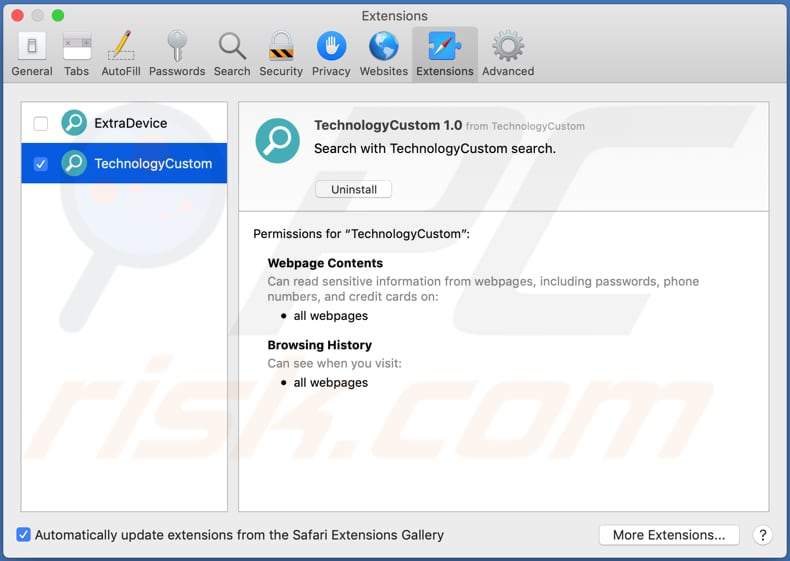
In the preferences window select the Extensions tab. Look for any recently installed suspicious extensions and uninstall them.
In the preferences window select General tab and make sure that your homepage is set to a preferred URL, if its altered by a browser hijacker - change it.
In the preferences window select Search tab and make sure that your preferred Internet search engine is selected.
Optional method:
Make sure your Safari browser is active and click on Safari menu. From the drop down menu select Clear History and Website Data...
In the opened window select all history and click the Clear History button.
Remove malicious extensions from Microsoft Edge:
Click the Edge menu icon (at the top right corner of Microsoft Edge), select 'Extensions'. Locate any recently-installed suspicious browser add-ons, and remove them.
Change your homepage and new tab settings:
Click the Edge menu icon (at the top right corner of Microsoft Edge), select 'Settings'. In the 'On startup' section look for the name of the browser hijacker and click 'Disable'.
Change your default Internet search engine:
To change your default search engine in Microsoft Edge: Click the Edge menu icon (at the top right corner of Microsoft Edge), select 'Privacy and services', scroll to bottom of the page and select 'Address bar'. In the 'Search engines used in address bar' section look for the name of the unwanted Internet search engine, when located click the 'Disable' button near it. Alternatively you can click on 'Manage search engines', in the opened menu look for unwanted Internet search engine. Click on the puzzle icon near it and select 'Disable'.
Optional method:
If you continue to have problems with removal of the find.customsearch.info redirect, reset your Microsoft Edge browser settings. Click the Edge menu icon (at the top right corner of Microsoft Edge) and select Settings.
In the opened settings menu select Reset settings.
Select Restore settings to their default values. In the opened window, confirm that you wish to reset Microsoft Edge settings to default by clicking the Reset button.
- If this did not help, follow these alternative instructions explaining how to reset the Microsoft Edge browser.
Summary:
A browser hijacker is a type of adware infection that modifies Internet browser settings by assigning the homepage and default Internet search engine settings to some other (unwanted) website URL. Commonly, this type of adware infiltrates operating systems through free. software downloads. If your download is managed by a download client, ensure that you decline offers to install advertised toolbars or applications that seek to change your homepage and default Internet search engine settings.
Removal assistance:
If you are experiencing problems while trying to remove find.customsearch.info redirect from your Internet browsers, please ask for assistance in our malware support forum.
Custom Search Safari Extensions
Post a comment:
If you have additional information on find.customsearch.info redirect or it's removal please share your knowledge in the comments section below.