
The Chromium team has no plans to begin signing Chromium. That means 1Password has no way of knowing if your Chromium installation is safe. Switch to a browser that has been signed, like Chrome, Safari, or Firefox. Beta versions of Safari and Chrome: Use the 1Password beta. When comparing Chrome vs 1Password, the Slant community recommends 1Password for most people. In the question “What are the best online password managers?” 1Password is ranked 4th while Chrome is ranked 18th. The most important reason people chose 1Password is.
1Password works everywhere you do. Easily sign in to sites, use suggested passwords, and find what you need. Everything is available at your fingertips.
Get 1Password for:
If you’re using Safari, get to know 1Password for Safari.
Save a login
To save a login, enter your username and password. Then choose Save in 1Password.
To update an incorrect or incomplete login, make your changes, then choose Save in 1Password and click Update.
Fill logins and other items
To fill an item, click and choose it.
If 1Password suggests more than one item, you can use the arrow keys to select the one you want.
Or start typing to find it.
Use a suggested password
1Password suggests strong passwords when you’re changing a password or signing up for a new account.
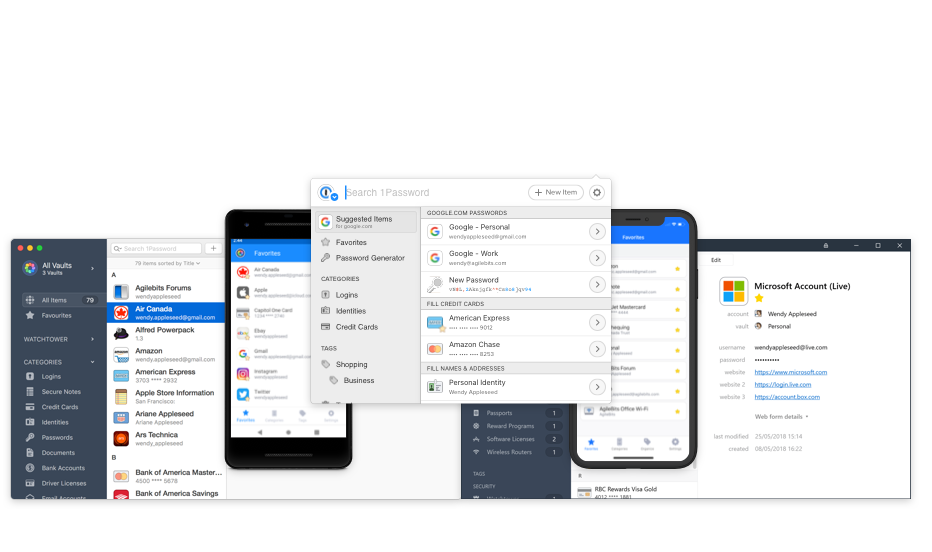

To use a suggested password, click in a password field and choose Use Suggested Password.
Create a custom password
You can use the 1Password pop-up to create custom passwords. To open the pop-up, click in your browser’s toolbar.
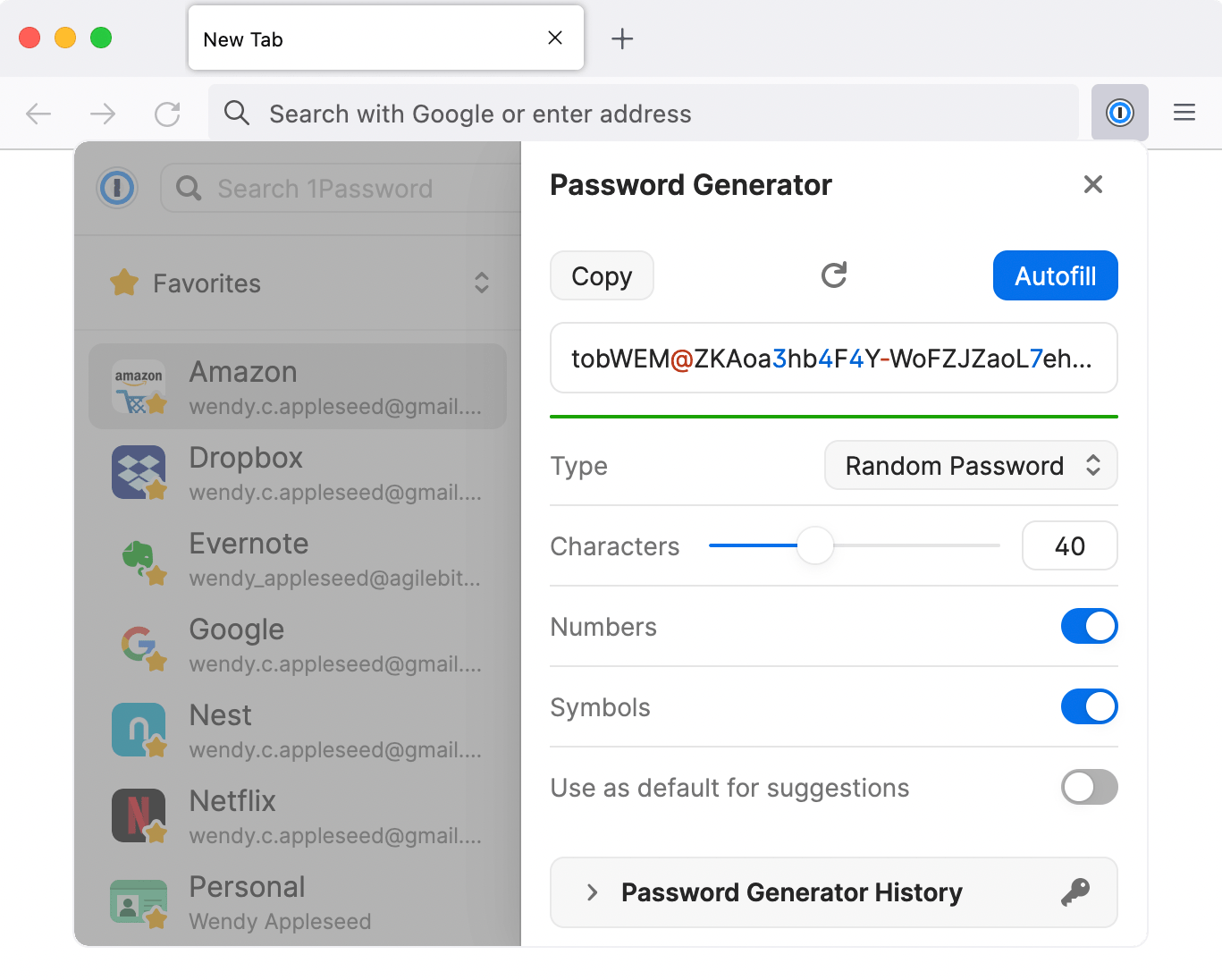
To create a custom password, click and choose Password Generator.
Adjust the settings for your new password, then copy it to the clipboard or fill it on the page.

To see all the passwords you’ve created, click Generator History below the password generator.
Search 1Password
Searching is the fastest way to find what you need in 1Password.
To search in 1Password, open the pop-up and start typing.
To cancel the current search, clickor press Esc.
View and edit items
To view an item’s details, click it. Or use the arrow keys to select it.
To mark an item as a favorite, click .
To copy any field, click it.
To open the pop-up in a new window, click .
To show a field in large type, click to the right of it, then click Large.
To reveal a password, click to the right of it, then click Reveal. Or press Control-Option (or Ctrl + Alt) to reveal all passwords in the item details.
To edit an item, click Edit. The item will open in a new tab, where you can add tags or custom fields, move it, or delete it.
Use drag and drop to fill in apps
To fill in an app, drag your login details from 1Password to it. For example, drag your password to the password field in the app.
You can also use drag and drop in your browser. Fill answers to security questions, membership numbers, and more.
Fill two-factor authentication codes
You can use 1Password as an authenticator for a site that supports two-factor authentication. First, find the site on 2fa.directory and follow the instructions to turn on two-factor authentication for the site.
When you see a QR code for 1Password to scan, click to scan it.
Switch accounts and vaults
To see a list of your accounts and vaults, click > Vaults.
To see everything, click All Vaults. To see only the items for a specific account or vault, click it.
To set which vaults are included when you view All Vaults, click next to All Vaults, then adjust the vaults under Accounts and Vaults.
Use Watchtower
Watchtower tells you about password breaches and other security problems on the websites you have saved in 1Password.
If any of your items require action, you’ll see an alert banner with more information at the top of the item in 1Password.
To get alerted when a website you have an account for is added to Watchtower, click > Settings. Then turn on “Watchtower alerts”.
Lock 1Password
When you’re done using 1Password in your browser, you can lock it. To lock 1Password, click > Lock 1Password.
1Password will automatically lock when:
- you quit the browser
- you don’t use your computer for a certain amount of time
- your computer sleeps
Chromium 1password Tutorial
Manage your settings
To manage your settings, click > Settings. You’ll be able to:
- Change your auto-lock settings
- Check for vulnerable passwords
- Change the language
- Adjust the toolbar button appearance
- Change which item list 1Password opens with
- Allow notifications
- Set a keyboard shortcut to open the pop-up
- Adjust how 1Password behaves on web pages
- Add and remove accounts; adjust All Vaults
- Make 1Password the default password manager
Get help
If you don’t see the 1Password icon in your browser’s toolbar
If the 1Password icon is missing from your browser toolbar, you can customize the toolbar to make it visible.
If your browser’s built-in password manager is interfering with 1Password
If your browser’s built-in password manager is interfering with 1Password, you can turn it off. Click in your browser’s toolbar, then click > Settings, and turn on “Make 1Password the default password manager”.
If you use different passwords for additional 1Password accounts
When you unlock 1Password in your browser, only accounts using the same password are unlocked. To unlock an account that has a different password, lock 1Password, then unlock it using the password for that account.
To make sure you always have access to your 1Password accounts, use the same password for all of them. If you signed up for accounts with different passwords, you can change them.
Learn more
About the message
For your protection, 1Password verifies the identity of your browser before filling your information, like passwords, credit cards, or addresses. When 1Password verifies your browser’s code signature, your information stays exactly where you expect it to: in 1Password or filled on the right page.
What you should do
Seeing this message does not always indicate a security problem. The solution may depend on which browser you are using.
Chrome or Firefox: Restart your browser
1password Edge Extension
1Password can’t verify the identity of your browser if it’s in the middle of an update. Quit your browser and restart it. Doing so will allow the update to complete, and the signature will once again be valid.
Chromium 1password Download
Chromium: Use a browser that has been signed
The Chromium team has no plans to begin signing Chromium. That means 1Password has no way of knowing if your Chromium installation is safe. Switch to a browser that has been signed, like Chrome, Safari, or Firefox.
Beta versions of Safari and Chrome: Use the 1Password beta
If you use a beta version of a major browser, like Safari Technology Preview, use the latest beta version of 1Password.
If you still see this message
If none of the above suggestions helped, try the steps below.
1password X Edge
Place browsers in the Applications folder
1Password for Mac can only reliably verify the signature of your browser if it is in the Applications folder. If your browser is in a subfolder or somewhere else on your Mac, move it to the Applications folder.
Restart your computer
Restart your computer before going further. It’s a simple step with no downside.