

- Cisco Anyconnect No Local Lan Access
- Cisco Anyconnect Secure Mobility Vpn
- Cisco Anyconnect Local Lan Access Not Working
- Cisco Anyconnect Local Lan Access
How to allow local LAN access while connected to Cisco VPN? Cisco VPN stops Windows 7 Browsing. Trick out cisco vpn with routes. Configuring Windows VPN Connection from Cisco AnyConnect. Cisco VPN Client - AnyConnect: connection problems. Local LAN access Local LAN access is desired when the Full tunneling is configured (Send all traffic through VPN) but users still desire to their local network for printing, etc For example, a client that is allowed local LAN access while connected to the MX in full tunnel mode is. If an AnyConnect policy enables Always-On and a dynamic access policy or group policy disables it, the client retains the disable setting for the current and future VPN sessions as long as its criteria match the dynamic access policy or group policy on the establishment of each new session.
| This article refers to the Cisco AnyConnect VPN. If you're looking for information on the Prisma Access VPN Beta that uses the GobalConnect app, see: Prisma Access VPN Landing Page. If you're not sure which service you're using, see: How do I know if I'm using the Cisco AnyConnect VPN or the Prisma Access VPN? |
Answer
Cisco Anyconnect No Local Lan Access
- Start Cisco Anyconnect VPN.
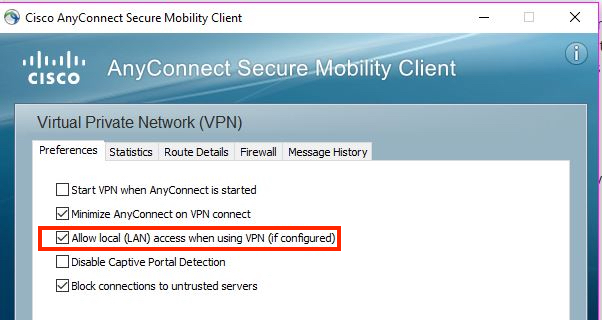
- From the menu select: Cisco Anyconnect VPN Client > Preferences
- Check the box next to Enable Local LAN access (if configured).
- Your settings changes will not take effect until the next time you start the VPN client. Quit the VPN client.
- Restart Cisco Anyconnect VPN and connect to the MIT VPN.
Result: You should be able to print to your home printer.
See Also
If you are a network engineer in this day and age, then you are probably familiar with and regularly using IPv6 (at least on your home lab network). I personally run my home network dual-stacked and have been recently annoyed by how VPN clients (mostly Cisco AnyConnect) handle dual-stacked clients. I have found that when left unconfigured (using defaults), AnyConnect likes to dump all IPv6 traffic silently on dual-stacked clients. Affinity photo free online course. This causes IPv6 enabled public websites and services (just the unpopular ones…like Google, YouTube, Facebook, etc) to hang while trying to connect using the looked up AAAA DNS record.
Here are a few tricks I have found to configure AnyConnect to properly handle dual-stacked clients to keep those eyeballs happy. The IPv6 must flow!
Using Local Internet
If your VPN is configured as a “split tunnel” which does not tunnel internet-bound traffic back over the VPN, then you will likely want to use this in your configuration as it has AnyConnect allow the client to send all their IPv6 traffic directly out the clients own internet connection.
If you do tunnel all internet traffic over the VPN, but do not have IPv6 capabilities on the VPN concentrator, then this may still be the solution for you. Keep in mind that if you are tunneling all IPv4 traffic back to the concentrator so you can perform filtering, then this solution may bypass that filtering for IPv6 traffic since it will not get sent over the tunnel.
This method is a good baseline configuration to use on any installation where internet traffic does not need to be filtered centrally as it prepares the AnyConnect system to properly handle IPv6-enabled clients.
What It Does:This configuration example will enable IPv6 over the VPN and assign an address to your VPN clients. It will then setup a split tunnel for IPv6 to tunnel over only the 1::1/64 network (which isn’t used). Top rated apple laptop. This tells the VPN client to exclude all other IPv6 traffic from the tunnel, allowing the PC to use the local internet for IPv6.
1.3 Responsibilities: See Safety Management System Manual, Chapter 2, Safety Responsibilities 1.4 General: This manual establishes the SMS policies for all employees of the CCRTA. 1.5 Issue and Update: The control of this manual is in accordance with the Process for SMS. The SMS text message is limited to 140 Octets or 1120 bits in length. There are a few alphabets that can be used to encode the SMS text message. Shown below is the default GSM 7 Bit ASCII alphabet for encoding SMS Messages. SMS Text messages may also be encoded in. Sms pdf. This revised version of the SMS Methodology document incorporates and consolidates information on how investigation results impact a carrier’s prioritization status in each BASIC. These revisions to the SMS Methodology document are intended to make information regarding the SMS methodology easier.
Cisco Anyconnect Local Lan Access
2 4 6 8 10 12 | ip local pool VPNPOOL10.1.160.0-10.1.160.254mask255.255.255.0 ! group-policy SSLVPN_GP attributes vpn-simultaneous-logins100 split-tunnel-policy tunnelall address-pools value VPNPOOL |