
Nationality: American. Born: New York, New York, 1947. Education: Harvard University, A.B. 1969, A.M. 1972; postgraduate study at Magdalen College, University of Oxford, 1976-77. Military Service: British Merchant Navy; infantrymen, Israeli Army, and field security officer, Israeli Air Force, 1972-73; British Merchant Navy. Career: Instructor, Harvard University; senior fellow, Hudson Institute; advisor, Bob Dole presidential campaign, 1996; journalist and contributing editor, Wall Street Journal.Awards: PEN/Faulkner award, 1982; National Jewish Book award, 1982; Prix de Rome (American Academy and Institute of Arts and Letters), 1982; Guggenheim fellow, 1984.
Mark Helprin Memoir from Antproof Case (excerpt from novel, pp. 307-314) Poisoned by Champagne (If you have not done so already, please return the previous pages to the antproof case.). Memoir from Antproof Case by Mark Helprin (2007, Trade Paperback) The lowest-priced brand-new, unused, unopened, undamaged item in its original packaging (where packaging is applicable).
PUBLICATIONS
Novels
Refiner's Fire: The Life and Adventures of Marshall Pearl, a Foundling. New York, Knopf, 1977.
Winter's Tale. San Diego, California, Harcourt, 1983.
A Soldier of the Great War. San Diego, California, Harcourt, 1991.
Memoir from Antproof Case. New York, Harcourt, 1995.
Fiction (for children)
Swan Lake, illustrated by Chris Van Allsburg. Boston, Houghton, 1989.
A City in Winter: The Queen's Tale, illustrated by Chris VanAllsburg. New York, Viking, 1996.
The Veil of Snows, illustrated by Chris Van Allsburg. New York, Viking, 1997.
Short Stories
A Dove of the East, and Other Stories. New York, Knopf, 1975.
Ellis Island and Other Stories. New York, Seymour Lawrence/Delacorte, 1981.
Other
Introduction, Manhattan Lightscape, photographs by Nathaniel Liebe. New York, Abbeville Press, 1990.
Preface, Moby Dick, or, The Whale by Herman Melville. New York, Barnes & Noble Books, 1994.
Foreword, Only Spring: On Mourning the Death of My Son byGordon Livingston. San Francisco, HarperSanFrancisco, 1995.
Contributor, In the Name of the Father: Stories About Priests, edited by Michael F. McCauley. Chicago, T. More Press, 1983.
Contributor, Reinventing the American People: Unity and Diversity Today, edited by Robert Royal. Grand Rapids, Michigan, William B. Eerdmans Publishing Company, 1995.

Editor, with Shannon Ravenel, The Best American Short Stories, 1988, 1989.
* * *
Mark Helprin is a Jewish-American novelist, essayist, and short story writer. His stories and essays have appeared in The New Yorker, The Atlantic Monthly, The New Criterion, The Wall Street Journal, and the New York Times. His fiction blends flights of fantasy with realism, so that he has been often compared with Colombian magical realist author Gabriel García Marquéz. Helprin writes thick, ambitious novels full of bizarre and mystical complications. His characters have a larger-than-life fairy-tale quality; they are fervent believers in the richly lived life and the conviction that love and beauty will prevail. Though his plotting and characterization are occasionally fantastical, his settings and dialogue are in the realist tradition.
Tradition is a key word to use when describing Helprin. Politically and literarily conservative, Helprin is a senior fellow of the Hudson Institute, where he writes on foreign policy and defense issues, his specialty being Middle East Studies.
Yet Helprin's life has been so full of adventure that many commentators have accused him of flat-out falsehood. Helprin grew up in the British West Indies, attended Harvard and the University of Oxford, and balanced this apparently bookish side of his nature by serving in the British Merchant Navy, the Israeli infantry, and the Israeli Air Force, and is an avid mountain-climber.
During the late 1970s, he became an Israeli citizen and went on dozens of counter-infiltration patrols at the Lebanese border. The experiences he gained there became materials for his short fiction, much of which was gathered into two early collections, A Dove of the East and Other Stories, which contains some fantastic elements, and Ellis Island and Other Stories. The latter won the 1982 National Jewish Book Award in America, was awarded a Guggenheim Fellowship and the Prix de Rome, and was nominated for the P.E.N. Faulkner Award and the National Book Award.
Helprin's short fiction foreshadowed what was to come. These stories deal with children, old reminiscing men, travelers in many exotic lands, rabbis, war, love, beauty, guilt, and death. Some recurrent images that symbolize life and love are Helprin's use of light, color, and music.
Like the short fiction, Refiner's Fire: The Life and Adventures of Marshall Pearl, a Foundling contains many autobiographical incidents. It is a rollicking bildungsroman about an orphan born on an illegal immigrant ship attempting to fight its way through the British naval cordon around Palestine during a sea battle in 1947 (the year of Helprin's birth). Adopted by a wealthy couple of the Hudson River Valley, Marshall leaves the United States for Israel and joins the army to fight in the 1973 Israeli-Arab war, as Helprin did. The novel is episodic, jumping from one continent to another, from one extravagant adventure to another. Marshal swims through a hurricane, romances various women, endures epileptic fits, and finds glory in a climactic battle on the Golan Heights. The novel was both praised and condemned for its 'old-fashioned' writing style; some critics faulted Helprin for its romanticism, its shallow characterization of women, its length. However, most agree that Refiner's Fire has moments of dazzling lyrical prose and transcendent perception.
Helprin's greatest novel is Winter's Tale, an epic fable set in an imaginary New York, potentially the site for the establishment of the New Jerusalem. The century-long story begins with a talking horse and an itinerant mechanic/thief named Peter Lake and concludes with an ambiguously redemptive apocalypse. A fairy tale that includes science-fictional conventions such as extraordinary machines and time travel, Winter's Tale possesses an intricate plot with a huge cast of characters.
One winter night at the turn of the twentieth century, Peter attempts to burgle a mansion on the Upper West Side. He unexpectedly meets beautiful heiress, Beverly Penn, and they fall in love. However, Beverly is dying of consumption, and when tragedy befalls them, Peter makes up his mind to 'stop time and bring back the dead.' He and his magical horse vanish into a mysterious 'cloud wall,' and the narrative jumps seventy years ahead. The reader now journeys with a young man from San Francisco to New York in search of a transcendent city. He endures several humorous adventures before witnessing an inferno that rages across Manhattan and heralds the millennium. In the year 2000, New York becomes a golden city, kingdom of heaven on earth.
The novel is remarkable in its sweep of wondrous and mysterious detail—such as a house in the middle of a lake, an impossible bridge, and a nineteenth-century village lost in winter somewhere beyond the city and the bounds of time—with broad strokes of comedy, villainy, tragedy, and exaltation. The treasures of the earth, Peter Lake says, are movement, courage, laughter, and love. Helprin provides these in generous abundance. The novel was critically acclaimed and became a national best-seller.
His next book, A Soldier of the Great War, also received warm attention. In August 1964, Alessandro Giuliani, an elderly Italian, unexpectedly finds himself walking the road to a town seventy kilometers away with an illiterate seventeen-year-old factory worker. To pass the time on their two-day journey, Alessandro tells the boy the story of his life. As a young man, he had ridden horses, climbed mountains, studied painting and aesthetics, and fell in love. Then World War I interrupts his life and he loses the girl of his dreams. Passionate, romantic, Alessandro becomes a soldier and hero while learning the horror and brutality of war, fighting in northern Italy, fighting with Sicilian bandits against the Italian army, fighting the Germans. He is imprisoned by the Austrian emperor's Hussars, then becomes a deserter. The hell of war and the insanity of the bureaucratic world are embodied in the person of Orfeo Quatta, a grotesque figure laboring in a dusty government office.
Alessandro enthralls his companion with stories about religion, politics, and morality, about the family he built and loved and lost. Through narrating his life of adventure, horror, absurdity, and loneliness, Alessandro finally understands the meaning of his retreat into his memories and realizes that in death he will join those he loved. Helprin told an interviewer that what he really meant by 'The Great War' is the war which we fight against conditions of mortality—in other words, life. Critical response to A Soldier of the Great Warwas almost unanimously positive, with many calling it Helprin's 'masterpiece.'
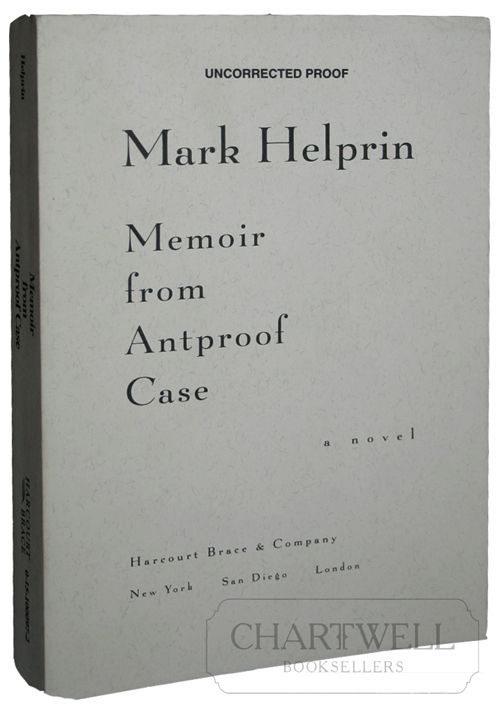
Helprin's next novel was a brilliant work of dark comedy. Memoir from Antproof Case is narrated by an ancient American hiding out in Brazil from real or imagined assassins. The old man writes his life story and carefully secretes the pages in an ant-proof case for his beloved ten-year-old stepson to read when he is older. Why must these adventures be hidden? Perhaps the boy will be able to find the tens of millions in gold bullion that his father stole years earlier.
The narrator, who comically refuses to give his real name but introduces himself as 'Oscar Progresso,' claims to have been a murderer, a patient in a Swiss insane asylum, a lover to rival Don Juan, a billionaire, a World War II fighter pilot who was shot down twice, the greatest bank robber of the century, a protector of the innocent, a banker who met with popes and presidents, and a constant crusader against 'the greatest enslaver of mankind: coffee.' Progresso may be eccentric, to put it mildly, but he is also a man who possesses good and evil in large portions, a man who dizzies with the sheer joy of life.
Helprin has also written stories for children with the noted author and illustrator Chris Van Allsburg. Swan Lake is a popular and acclaimed reworking of Tchaikovsky's ballet about Odette, an orphaned princess. A City in Winter is narrated by a young queen whose parents were slaughtered by the evil Usurper, so that she was raised deep in the forest until, at the age of ten, she journeyed to reclaim her kingdom. Helprin's storytelling is still both comical and fantastical, though some reviewers complained that the tale is too violent and wordy for children. The Veil of Snows takes up the story some years later, when the Queen has ruled in peace but worries because her husband and his army have vanished in the wilderness. A battle with the vile Duke of Tookisheim foreshadows her greatest fear—the return of the cruel Usurper. Her faithful tale-singer joins forces with her to overthrow the invaders against enormous odds.
In both his juvenile and adult fiction, Helprin's themes of loyalty and courage in the face of danger, the heartless efficiency of evil, and the power of love to endure and prevail burn like a steady flame. Helprin credits Dante Alighieri as his greatest literary influence, an influence evident in his fables of redemption and revelation gained by surviving the terrible and beautiful vicissitudes that life has to offer. His fiction is sublime in its portrayal of great suffering and great joy. His novels present lionhearted, if occasionally foolhardy, quests for truth and love. What his fans cherish most is Helprin's certitude that life is worth living to the fullest, and that even in the face of death, the world is still full of hope.
Additional topics
Brief BiographiesBiographies: Bob Graham (1942-) Biography - Awards to Francis Hendy Biography - Born to Sew
And I'd just say, ladies and gentlemen, one of the qualities of American politics that distinguishes us
from other nations is that we judge our politicians as much by the manner in which they leave
office as by the vigor with which they pursue it. You do not lay claim to the office you hold, it lays
claim to you. Your obligation is to bring to it the gifts you can of labor and honesty and then to
depart with grace. And my time to leave this office has come, and I will seek the presidency with
nothing to fall back on but the judgment of the people, and nowhere to go but the White House or
home.
Six times - six times I've run for Republican leader of the United States Senate and six times my
colleagues, giving me their trust, have elected me, and I'm proud of that.
So my campaign for the president is not merely about obtaining office. It's about fundamental
things, consequential things, things that are real. My campaign is about telling the truth, it's about
doing what is right, it's about electing a president who's not attracted to the glories of the office, but
rather to its difficulties. It's about electing a president, who once he takes office, will keep his
perspective and remain by his deepest nature and inclination one of the people.
Therefore, as the campaign for the president begins in earnest, it is my obligation to the Senate and
to the people of America to leave behind all the trappings of power, all comfort and all security.
Memoir From Antproof Case Review
So today (Wednesday, May 15, 1996) I announce that I will forego the privileges not only of the
office of the majority leader but of the United States Senate itself, from which I resign effective on
or before June 11th. And I will then stand before you without office or authority, a private citizen,
a Kansan, an American, just a man. But I will be the same man I was when I walked into the room,
the same man I was yesterday and the day before, and a long time ago when I arose from my
hospital bed and was permitted by the grace of God to walk again in the world. And I trust in the
hard way, for little has come to me except in the hard way, which is good because we have a hard
task ahead of us.
-Bob Dole's resignation speech from the U. S. Senate (written, at least in part, by Mark Helprin)
Since at least the publication of Winter's Tale, Mark Helprin has been hailed as a writer's writer. This generally means someone who gets stellar reviews from the critics for the quality of his prose and his use of language, but who pays little attention to either formal plot or the desire of the average reader to comprehend what the author's up to. I've read, or tried reading, all of his novels, many of his short stories, and even his children's books, and I readily admit that while he does write beautifully at times, I find it daunting to try to wend my through the 500 or so pages he typically serves up. I'm not someone who is willing to forgo narrative structure just because the words are pretty.
Memoir From Antproof Case Mark Helprin
However, especially in recent years, Helprin has emerged as one of the most graceful and consistently insightful conservative columnists in America, writing mainly in the pages of the Wall Street Journal. In addition, in both the speech above and in the portion of the 1996 GOP Convention speech that he wrote, Helprin performed the nearly miraculous feat of making Bob Dole sound eloquent. So I keep reading his books, just waiting for the one that will combine his political ideas, his imagination, and his beautiful language into a truly great book. In my opinion he still has yet to achieve this greatness, but in Memoir from Antproof Case he seems to be getting closer.
For one thing, the book has a fascinating and frequently hilarious protagonist, an old man hiding out from assassins in Brazil--a life as an orphan, fighter pilot, billionaire, murderer, and much more behind him--consigning his colorful life story to the antproof case that will protect them so that his wife's son by another man can eventually read them. The memoirs would be amusing enough on their own, but even more enthralling are his obsessions and phobias, chief among them his hatred of coffee. the 'evil bean that enslaves half the world.'
Though still an over bounteous smorgasbord of a book, it benefits from a much more defined sense of narrative direction than some of Helprin's others and that goes a long way towards carrying the reader through the lulls and misdirections. This isn't yet the great novel he's going to write one day, but it's well worth reading.
(Reviewed:)
Grade: (B-)